For years, business visibility followed a familiar route: publish a useful website, keep business listings accurate, earn credible mentions, and measure what turns visits into sales. A new management surface has entered that workflow.
On November 10, 2026, OpenAI introduced Businesses in ChatGPT in beta. Its Business Hub lets eligible organizations claim a profile, verify their authorization and supply current business information. It also offers aggregated data about how a business is encountered in ChatGPT.
One distinction matters immediately: claiming a business does not guarantee that ChatGPT will recommend it.
What Business Hub actually does
Business Hub is designed for owners and authorized business representatives. Once the claim and identity verification have been approved, an eligible business can update its website, description, category, logo, and other supported details. Eligible merchants may also connect product feeds containing prices and availability.
This gives businesses a direct path to submit accurate information. OpenAI still reviews updates, and ChatGPT can use other sources when answering. A verified profile does not control independent recommendations.
How to claim your business in ChatGPT
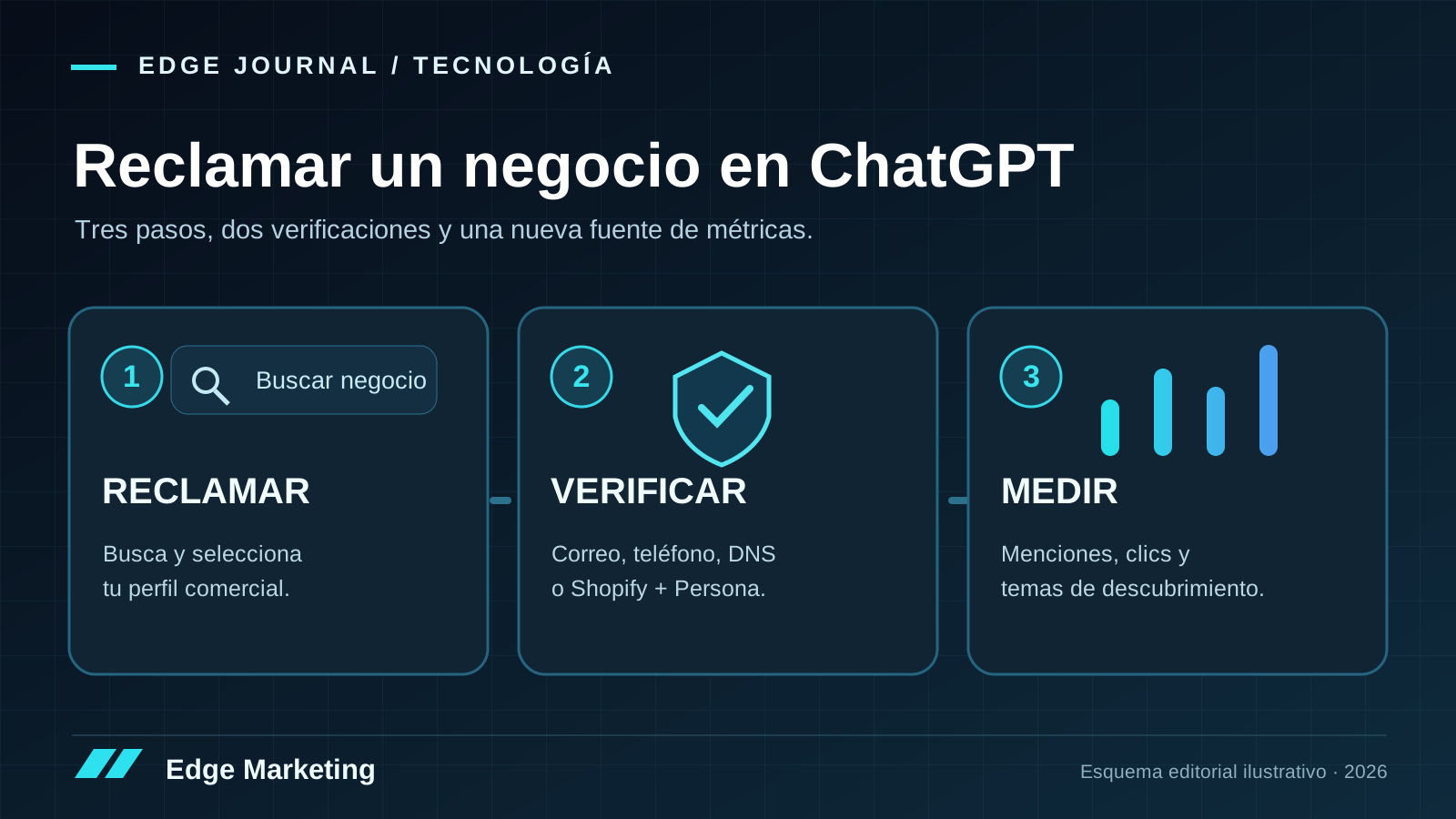
Open chatgpt.com/business-hub and follow the path available to your business:
- Sign in to ChatGPT and open Business Hub from the sidebar.
- Search for your business, select the correct profile, and choose the account that will manage it. Some eligible online businesses can add a new profile if one does not exist.
- Select an offered verification method: business phone, business email, website domain or Shopify.
- Complete verification. For website domains, add the exact DNS TXT record supplied by ChatGPT.
- Submit the claim and follow OpenAI’s review instructions.
- Complete the separate Persona identity check. Domain or email verification alone does not unlock full profile management or the blue verified badge.
Persona may require a government ID, business registration information and evidence of authorization. Details must match official business records. A pending claim is not an approved claim.
What Business Hub insights can tell you
After both approvals, Business Hub provides aggregated insights covering the previous 28 days: mentions, website clicks and discovery topics.
For an online business, a mention requires ChatGPT to reference its website; mentioning the brand by name alone does not count. For a local business, a mention can be counted when ChatGPT displays its location result.
Discovery topics are grouped themes, not individual user prompts and not a direct measurement of purchase intent. Businesses cannot access people’s private conversations. Blank metrics do not necessarily indicate zero activity; privacy thresholds or reporting limitations may apply.
These signals are useful for understanding exposure, but they do not independently prove leads, bookings, purchases or revenue.
Eligibility outside the United States
OpenAI says eligible businesses where ChatGPT is supported may claim a profile if the required verification is available. Access depends on location, industry and business type.
There is a meaningful restriction: physical stores and restaurants can currently claim only an existing US location listing. A restaurant in Quito should not assume its local listing can already be claimed.
An eligible digital agency, ecommerce operation or online service outside the US can check Business Hub for its specific options, but eligibility must not be presented as confirmed in advance.
Business Agents are separate from claims. Agents currently require an eligible US ecommerce or online service business with a website and must satisfy additional policy requirements. A claimed profile does not automatically qualify for an agent.
What changes for SEO and AI search
Some marketers are describing Business Hub as a shortcut to the top of ChatGPT results. OpenAI does not support that claim. Verification is not a ranking guarantee, and advertising does not determine independent answers.
An eligible business also does not need an Enterprise subscription or an Ads account solely to claim its profile. Claiming, advertising and publishing an agent are separate activities.
The practical work remains familiar: reliable website content, accurate business details, clear service coverage, up-to-date product information, authentic reputation signals and conversion measurement.
For Edge Marketing, Business Hub is an important new place to check how a brand is represented. It complements technical SEO, local search, analytics and AI-search visibility efforts. It does not replace them.
Official sources: OpenAI announcement, November 10, 2026 · Setup and eligibility guide · Business Hub.
Explore Edge Marketing for website strategy, technical SEO and AI-search visibility.
Editorial note: the illustrations are conceptual, not screenshots of OpenAI’s Business Hub. Details checked on November 21, 2026. Eligibility and product features can change.